
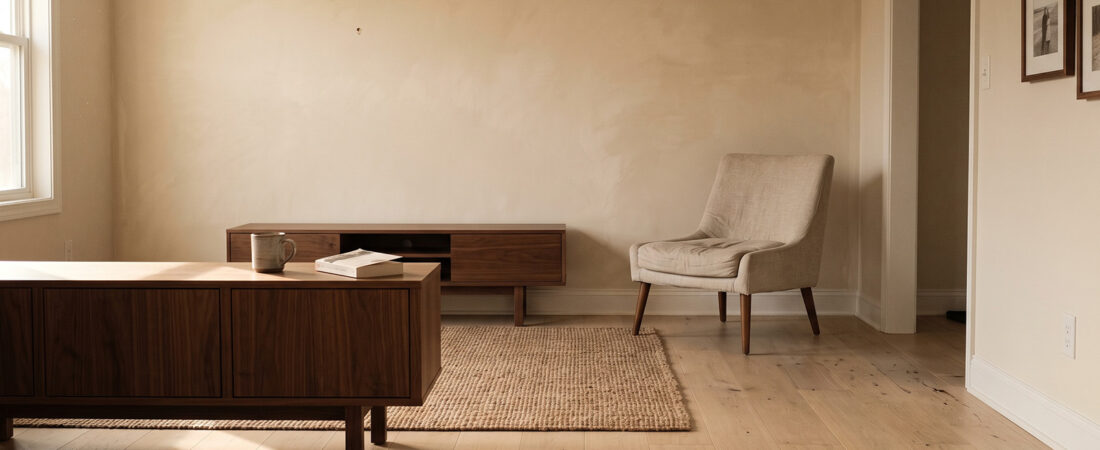
The reason your Japandi room feels cramped is probably not square footage. It is that your furniture was designed for a market that equates comfort with bulk, and you put it in a style built on the opposite assumption.
American upholstery runs tall, deep and heavily stuffed. Rolled arms, thick cushions, high backs, chunky legs, seat heights that keep climbing. Individually those pieces are comfortable. Collectively they fill the vertical half of a room that Japandi needs left empty.
This is fixable, and a surprising amount of it is fixable without buying anything.
The numbers that actually matter
Most furniture shopping happens by eye. For this style you need a tape measure, because the difference between a piece that works and one that wrecks the room is often two inches.
| Element | Typical American | Japandi target |
|---|---|---|
| Sofa seat height | 18 to 21 inches | 14 to 16 inches |
| Sofa back height | 32 to 38 inches | 26 to 30 inches |
| Coffee table height | 18 to 20 inches | level with seat, or 1 to 2 inches below |
| Bed height with mattress | 24 to 30 inches | 16 to 20 inches |
| Side table height | 24 to 26 inches | 18 to 22 inches |
| Art center height | 57 inches | 50 to 54 inches |
Those Japandi figures are not arbitrary aesthetics. They come from a tradition where daily life happened closer to the floor, and they produce a measurable effect in a room: the horizontal line of your furniture drops, the upper wall opens up, and a standard eight foot ceiling reads as taller than it is.
Measure what you own before you shop. Most people are surprised by how far off they are.
Back height is the number nobody checks
Seat height gets all the attention. Back height does more damage.
A sofa with a 36 inch back cuts your wall in half at exactly the point where the eye wants open space. Standing in the doorway, you see furniture occupying the lower and middle bands of the room with a thin strip of wall left at the top. That reads as cramped regardless of how large the room is.
Drop the back to 28 inches and the same room reads as open, because the wall above it becomes continuous rather than interrupted.
If you cannot replace the sofa, you can still fix the wall above it. Remove any art hanging over a tall backed sofa entirely. Two competing horizontal masses stacked on one wall is the worst version of this problem. Bare wall above a tall sofa is significantly better than a gallery arrangement.
Legs, and why you should be able to see the floor
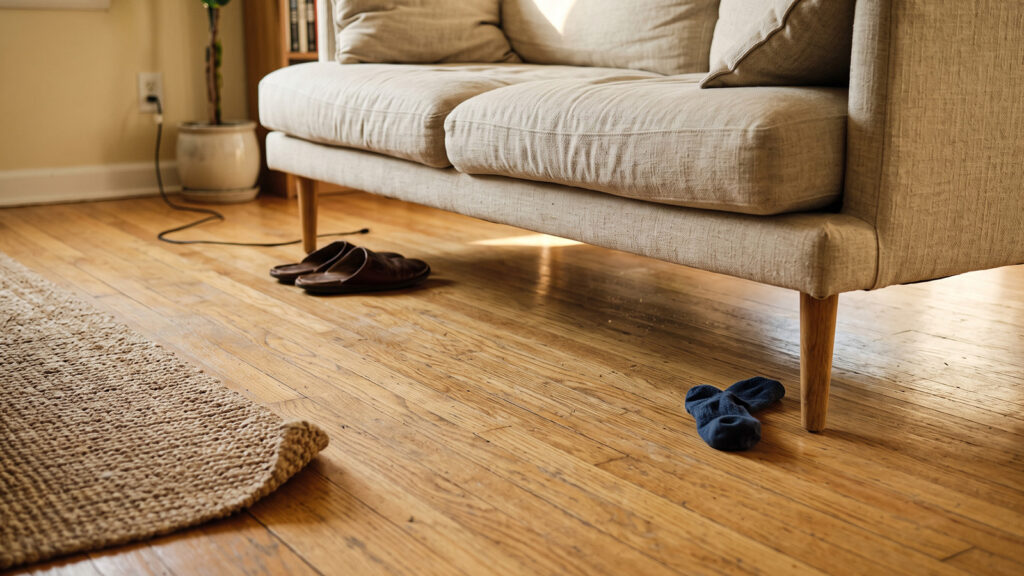
A sofa that meets the floor in a solid skirt sits in a room like a block. The same sofa on slim exposed legs appears to float, and the floor running underneath it is visible.
That visible floor matters more than it sounds. Continuous flooring under furniture makes a room read as larger because the eye follows the plane without interruption. It is the cheapest spatial trick available and it costs nothing but a purchasing decision.
Look for slim tapered legs in light oak or walnut with at least four inches of clearance underneath. Avoid skirted bases, plinth bases, and anything upholstered all the way to the ground. The rule applies whatever you buy and wherever you buy it.
Depth is where comfort actually lives
Here is where people assume Japandi means uncomfortable. It does not.
Low does not mean shallow. A Japandi sofa should be deeper than the American average even as it sits lower. Seat depth around 24 to 27 inches with a low seat height gives you a piece you can genuinely sink into, sit cross legged on, and stay in for three hours.
What you are giving up is not comfort. It is the upright, formal, high seated posture of traditional Western furniture. Low and deep is a lounging geometry, which is precisely why it suits a room designed for calm rather than for receiving guests formally.
Test this in a store by actually sitting, not by looking. If your knees end up slightly above your hips and you feel like reclining, the proportions are right.
Dropping the furniture is half the job. The other half is the wall you just opened up above it, and hanging the wrong thing there undoes the whole effect. The Complete Collection is all 17 assets across both palettes, the light rooms and the dark ones, so whichever direction the space goes you are not buying twice.
See the Complete Collection.

Coffee table relationships
A coffee table taller than the sofa seat creates a visual wall in the middle of your seating area. It is one of the most common proportion errors in American living rooms and one of the easiest to fix.
The rule: coffee table surface should sit level with the sofa seat or one to two inches below it. Never above.
Same logic for side tables. A side table should land at or just below the arm height of the chair beside it. Taller and it looms. Much lower and it becomes useless for setting down a cup.
These two swaps, coffee table and side table, will change a room more than a new sofa and cost a fraction as much.
Hang your art lower than feels correct
Standard gallery practice puts the center of a piece at 57 inches, roughly average standing eye level. In a room built around low furniture and seated living, 57 inches leaves art floating above everything else with a gap of dead wall between.
Drop it. Center at 50 to 54 inches, or hang relative to the furniture: leave roughly 6 to 8 inches between the top of a console or sofa back and the bottom of the frame.
It will look wrong on the wall while you are standing on a ladder and correct the moment you sit down. That is the entire point, because a Japandi room is designed to be experienced from a seated position.
The rearrangement that costs nothing
Before spending anything, do this in order:
- Remove one tall thing. A bookcase, a floor lamp, a tall plant. Any single vertical element over five feet. Live without it for a week.
- Lower your art. Every piece in the room, down four to six inches. Takes twenty minutes and a hammer.
- Swap tables. If a coffee table sits above seat height, trade it with any lower surface you own, even temporarily.
- Pull furniture off the walls slightly. Two to four inches of breathing room behind a sofa reads as intentional placement rather than furniture shoved into a room.
- Sit down and look. Assess from seated height, not standing. That is the height the room needs to work at.
Most rooms improve noticeably from those five moves. Whatever still bothers you afterward is a genuine buying problem, and now you know exactly what it is.
What to look for when you do buy
Clean rectangular geometry. Slim exposed legs in light oak or walnut. Tight cushions rather than overstuffed ones. Low backs. Arms that are either very low or absent entirely.
Avoid rolled arms, deep button tufting, nailhead trim, skirted bases, and anything a listing describes as overstuffed, plush, or generously proportioned. Those words are all signals of the American upholstery tradition this style is deliberately stepping away from.
One caution worth stating plainly. Low seating is harder to get out of, and that matters if anyone in the household has knee or hip issues. Japandi proportions are not universally appropriate, and a beautiful room that a family member struggles to use is a failed room. Compromise with a slightly higher accent chair in the same visual language rather than forcing the whole space down to 15 inches.
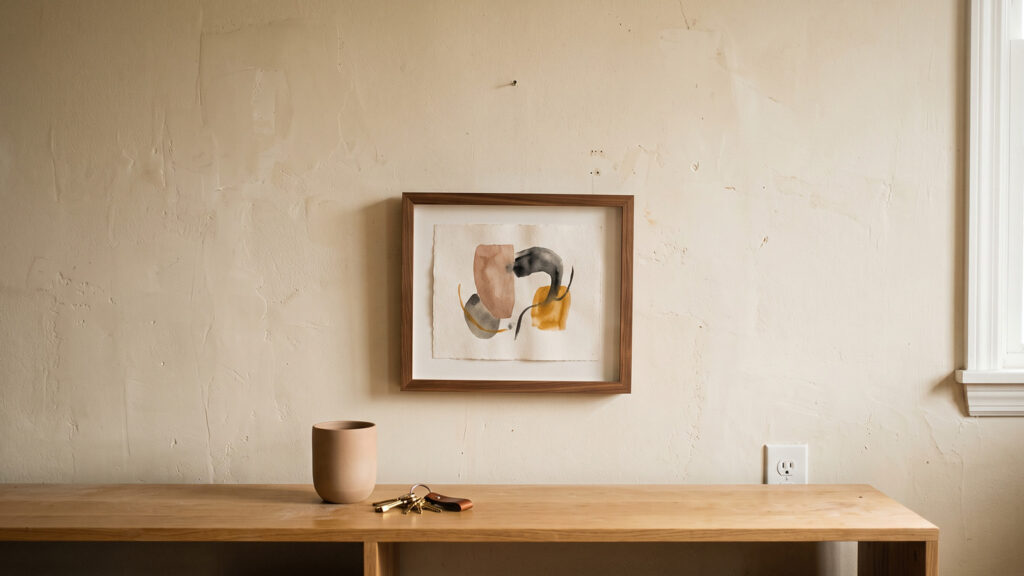
Dropping the furniture is half the job. The other half is the wall you just opened up above it, and hanging the wrong thing there undoes the whole effect.