
Materials
Why Your Minimal Room Echoes (And How to Fix It With Things You Already Wanted)
Minimalism has an acoustic cost nobody mentions. Why your Japandi room echoes, what slat panels actually do, and the clap test that tells you what to fix first.
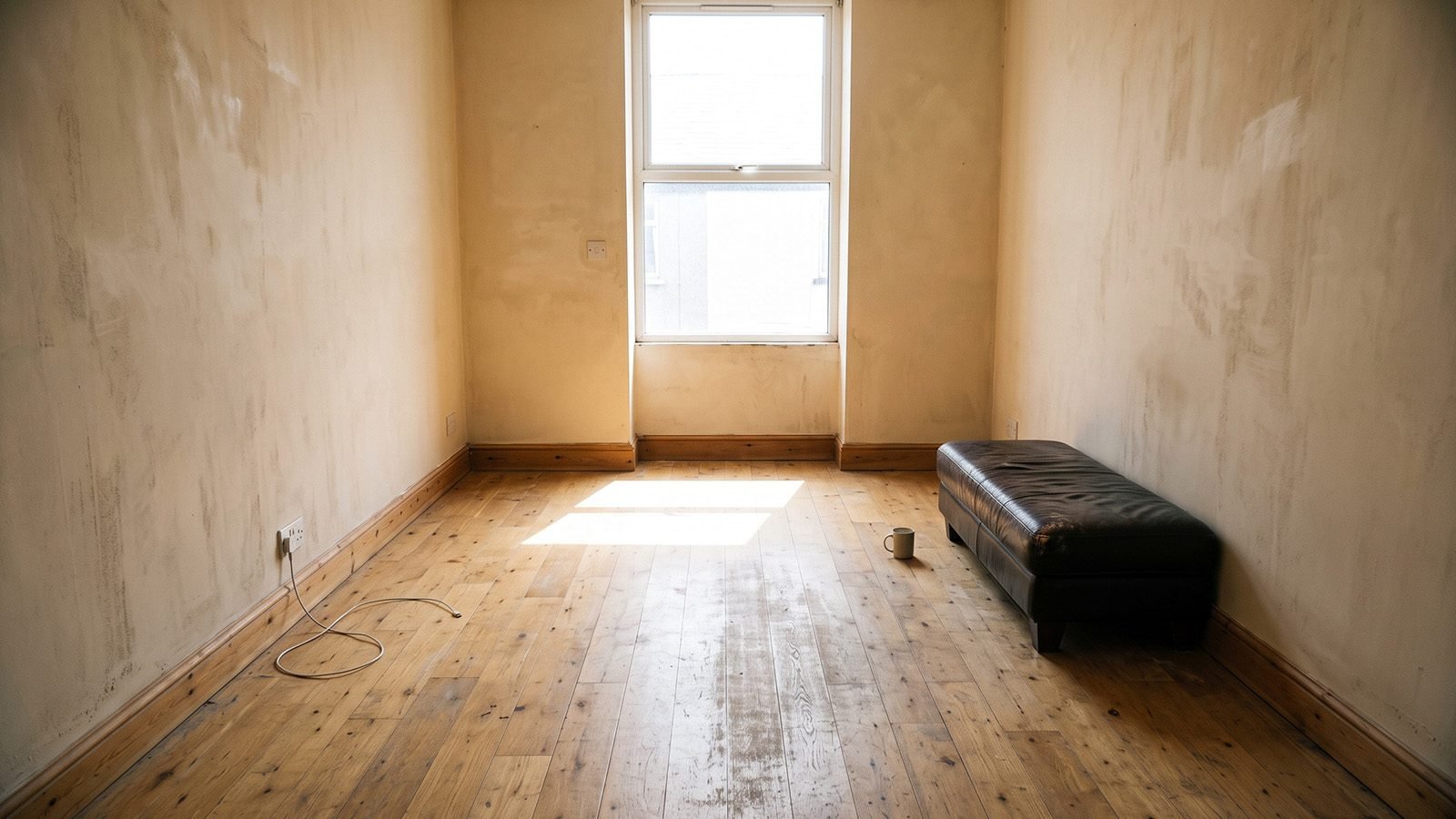
You removed the clutter, took down the heavy curtains, cleared the surfaces, and now your voice bounces off the walls and the television sounds harsh. That is not a coincidence. You removed the soft material that was doing the acoustic work and replaced it with nothing.
Minimalism has an acoustic cost that almost nobody mentions, and it is the reason a beautifully executed Japandi room can feel subtly unpleasant to be in without anyone identifying why.
What is actually happening
Sound leaving your mouth or a speaker travels outward and hits surfaces. Hard flat surfaces reflect almost all of it back into the room. Soft porous surfaces absorb some of it.
A conventionally furnished room is full of absorbers by accident: wall to wall carpet, heavy drapes, an overstuffed sofa, cushions, bookshelves stuffed with paperbacks, fabric wall art. Strip those out in pursuit of minimalism and you are left with plaster, glass, and hard flooring, which is a very reflective box.
Two specific problems result.
Reverberation. Sound persists after the source stops. Speech becomes less intelligible, music gets muddy, and the room feels large and cold in a way that has nothing to do with temperature.
Flutter echo. When two hard parallel surfaces face each other, sound bounces rapidly back and forth between them. You can test for this right now: stand between two bare parallel walls and clap once, sharply. If you hear a fast metallic ringing rather than a clean decay, you have flutter echo. It is one of the most common problems in minimal rooms and one of the most fixable.
Fix it with things that belong in the room anyway
Here is the useful part: nearly every acoustic fix a Japandi room needs is already part of the Japandi material palette. You are not adding foreign objects, you are adding the soft layer the style calls for and that you may have under-specified.
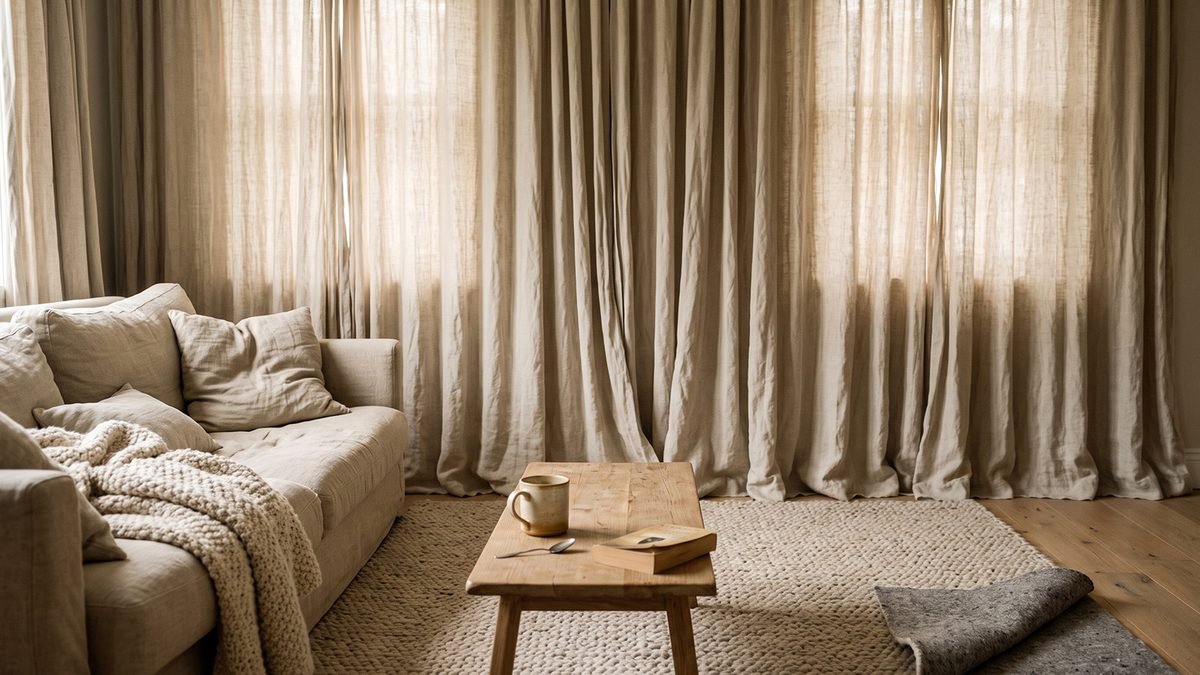
A large rug with a proper pad, in order of importance. Floor is usually the largest hard surface in the room and the first place to treat. The pad matters more than people expect, because it adds thickness and decouples the rug from the hard floor. A thin rug laid directly on wood does much less than the same rug over a felt pad. Wool outperforms jute here, since the denser fibre absorbs more than a coarse flat weave.
Floor to ceiling curtains, even where there is no window. Heavy unbleached linen hung across a bare wall is a legitimate acoustic treatment that happens to look correct in this style. Hung with generous fullness, meaning significantly more fabric width than the wall width, so the fabric gathers rather than stretching flat. Flat fabric does far less.
Upholstered seating with fabric rather than leather. Leather is beautiful and it is acoustically closer to a hard surface. If your room is echoing, a linen sofa is doing more work than a leather one.
Books, actually on shelves, actually irregular. A bookshelf full of books with varying depths scatters sound rather than reflecting it cleanly. This is one of the few cases where the styled minimal shelf, sparse and evenly spaced, is acoustically worse than a full one.
Fabric wall hangings. A large textile panel is the most direct treatment available and reads as intentional in this style rather than as acoustic equipment.
About wood slat panels
These are everywhere right now, and they are the visual signature of this style as much as anything. Worth being precise about what they do.
A slat panel is a series of wood strips mounted over a backing, usually felt. The wood itself does not absorb sound meaningfully. The absorption comes from the felt backing and from the air gap behind the panel, while the slats scatter reflections rather than sending them straight back.
What that means practically: the felt and the air gap are the product, and the wood is the appearance. A panel with a thin felt facing mounted flat against drywall will do considerably less than the same panel with a proper air cavity behind it. Manufacturers publish absorption figures for their panels, and those figures depend heavily on the mounting method used in the test.
We are not going to give you specific absorption coefficients here, because the numbers circulating in design articles vary wildly and we have not verified them against manufacturer test data. If you are buying panels for acoustic reasons rather than visual ones, ask the supplier for their test data and the mounting condition it was measured under. If they cannot produce it, you are buying decoration.
That is fine, incidentally. Slat panels look excellent. Just be clear which of the two things you are paying for.
Where to treat, in order
You do not need to treat every surface, and treating all of them makes a room sound dead and lifeless, which is its own unpleasant problem.
- The floor. Largest surface, biggest single improvement, and a rug is something the style wants anyway.
- One of any pair of parallel hard walls. You only need to break one side of a parallel pair to kill flutter echo. Curtains, a textile, or a slat panel on one wall solves it.
- Behind or beside the main seating. Where people talk. A fabric sofa plus cushions plus a throw is a surprisingly effective absorber cluster.
- The window wall. Glass is the hardest surface in most rooms. Full length curtains here fix acoustics and light diffusion at once.
- Stop. If the room sounds comfortable, adding more soft material starts removing liveliness.
The clap test, before and after
This costs nothing and tells you more than any online guide.
Stand in the middle of the room, clap once, sharply, and listen to what happens after. A clean short decay means the room is fine. A ringing or fluttering tail means flutter echo. A long smeared decay means general reverberation.
Then add one thing. A rug, or curtains on one wall. Clap again in the same spot. The change is usually obvious and immediate, and it tells you whether to keep going or stop.
Do this before you buy anything expensive. Most minimal rooms need a rug with a decent pad and one wall of fabric, and are then completely fine. The people who end up buying panels for four walls usually skipped the cheap fixes.
Most rooms that echo need a rug with a proper pad and one wall of fabric, in that order, and nothing else. The free Japandi Starter Guide covers the sequence for building the soft layer without overshooting into a room that sounds dead. Get the Japandi Starter Guide.