
Rooms
Japandi in a Rental: What You Can Do Without Touching the Walls
Most Japandi advice assumes you own the walls. The four elements that carry eighty percent of the effect are all removable. What to do, and what to accept.
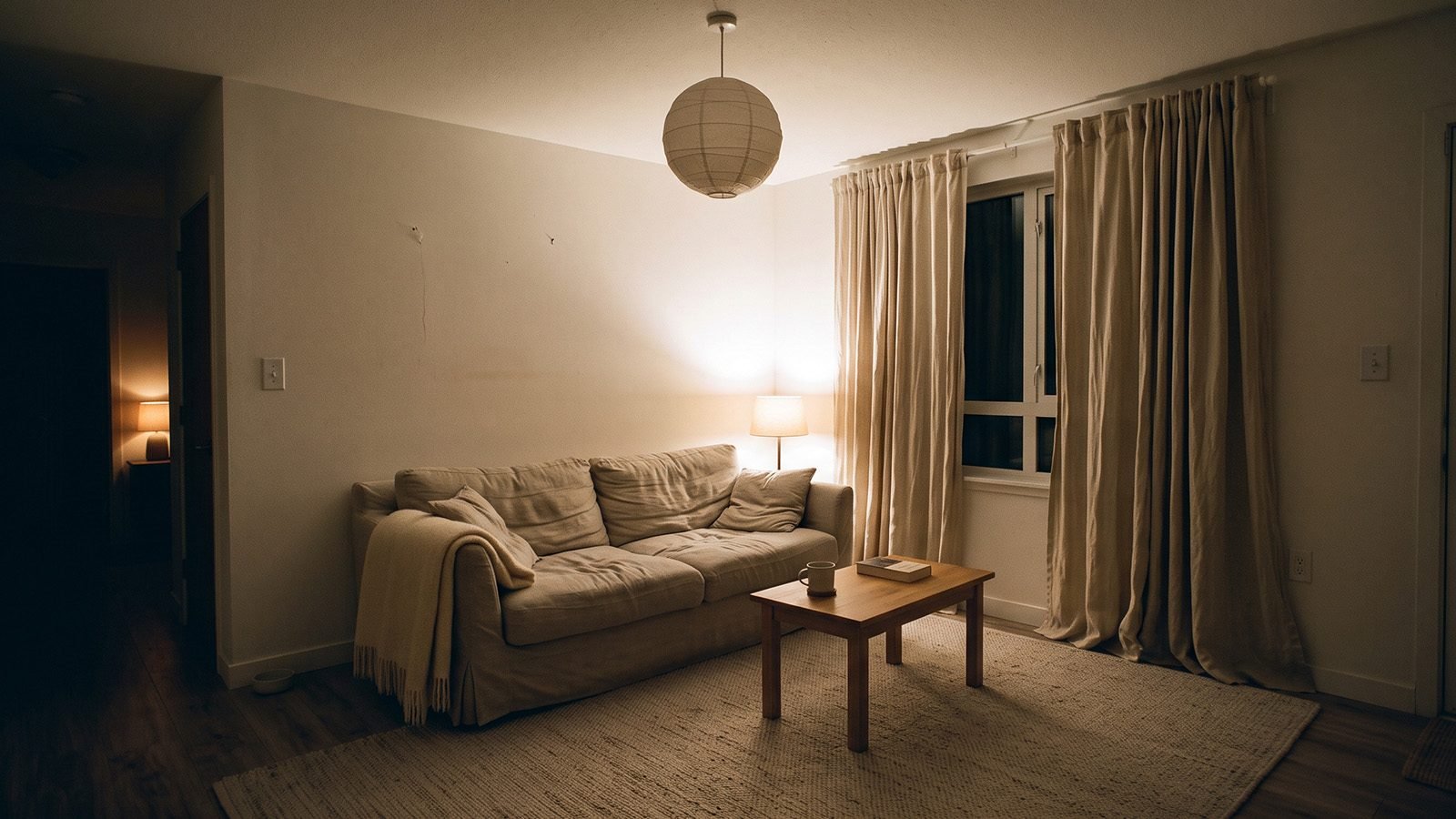
Almost every article about this style assumes you own the walls. Limewash, new flooring, cabinetry, built-in joinery. If you rent, most of that advice is a description of somebody else's house.
The useful news is that the four things that actually make a Japandi room work are all removable, and none of them touch the structure.
What actually creates the effect
Rank the elements of this style by how much they contribute and how permanent they are, and the list separates cleanly.
High impact, fully removable: light quality, textiles, furniture height and proportion, and subtraction. Those four carry roughly eighty percent of the result.
High impact, permanent: wall finish and flooring. Genuinely important, genuinely not available to you.
Which means a renter is not getting a compromised version of this style. They are getting most of it, and losing the two most expensive parts.
Bulbs first, always
Thirty dollars, one evening, and it changes the appearance of every surface in the flat including the ones you cannot change.
Rental lighting is usually the worst in any building: a single cool white overhead fixture per room, often 4000K or higher. That light renders warm wood grey, makes off-white walls look institutional, and flattens every texture you introduce.
Swap every ambient bulb to 2700K to 3000K. Then stop using the overhead fixture in the evening entirely and add two low lamps. A floor lamp and a table lamp, both warm, both at low output.
If your fixture is a bare bulb on a cord, a simple paper lantern shade costs very little and covers the single ugliest feature of most rentals.
Curtains are the biggest lever you have
In a flat you cannot paint, fabric is how you change a wall.
Hang them high and wide. Mount the rail close to the ceiling rather than just above the window frame, and extend it well past the window on both sides. This makes the window look larger and covers more wall.
Floor to floor, generous fullness. Heavy unbleached linen, gathered rather than stretched flat. The gather is what gives it depth and what does the acoustic work.
You can hang fabric where there is no window. A full height linen panel across a bad wall is a legitimate treatment, and it is the closest a renter gets to changing a wall surface.
Tension rods and removable adhesive fixings exist if you cannot drill. They hold less weight, so this is where lighter linen beats heavy wool.
Working around flooring you did not choose
Two problems dominate American rentals.
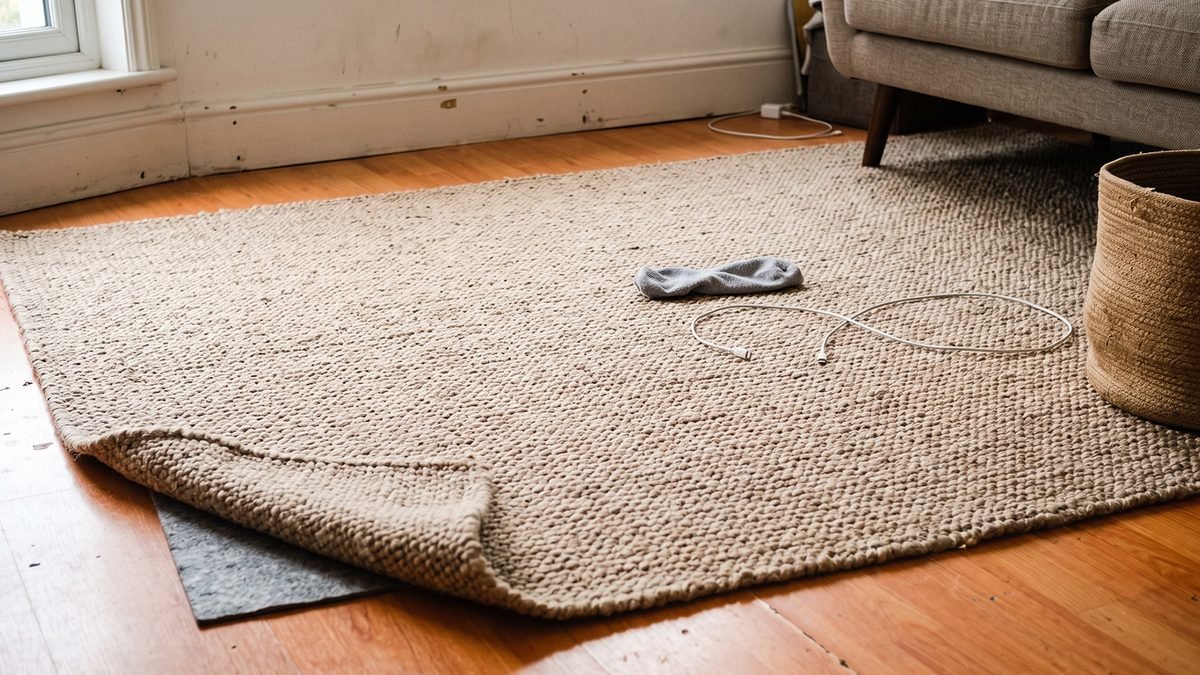
Orange-toned oak or pine. Very common, and it fights the warm-but-not-orange palette this style wants. The fix is to introduce a large flatweave rug in a warm neutral, which reduces the visible floor area, and to keep your wall tones warm rather than cool. Cool grey walls make orange floors look worse, not better.
Grey laminate or grey-washed wood. The opposite problem and harder. Grey flooring is cool-toned by definition and will fight every warm material you add. Same solution at larger scale: cover as much of it as you reasonably can with a warm rug, and lean warmer everywhere else to compensate.
In both cases the rug is not decoration, it is correction. Buy the biggest one the room and budget allow, because a small rug floating in the middle of a bad floor makes the floor more noticeable rather than less.
Cover rather than replace
The approach for everything you did not choose and cannot remove.
A sofa you inherited or cannot afford to replace: a well-fitted slipcover in oatmeal or cream linen. Not a throw draped over it, which slides and reads as concealment. A proper cover.
Kitchen cabinets you hate: removable adhesive film is genuinely usable now in matte finishes, though quality varies enormously and cheap versions look cheap. Test one door before committing. Changing the handles is often the better spend, since most rentals allow it if you keep the originals and put them back.
Bad tile or splashback: a matte film or, in a rental you are not staying in long, simply ignore it and put your effort where it shows.
Built-in wardrobes with mirrored doors: the single most common rental problem in bedrooms and the hardest. Mirrored surfaces fight this entire style. Options are film, a fabric panel, or accepting them and keeping everything else calm.
Furniture that moves with you
Buy for the next three flats, not this one.
Low and modular. Low furniture works in any ceiling height and modular pieces reconfigure into rooms of different shapes.
Nothing built to a specific wall. No custom shelving, no anything cut to fit an alcove you will leave.
Freestanding storage that is genuinely good. A low closed cabinet does the job of built-in joinery and comes with you. This is the piece worth spending real money on.
Lamps over fixtures. Every lamp you buy is portable. Every fixture you install stays behind.
The parts of the style that are free
Worth stating clearly, because renters are usually working with a tighter budget as well as tighter permissions.
Subtraction costs nothing. Ma and the reduction of objects is the highest-impact change in this style and it requires only removal.
Furniture arrangement costs nothing. Pulling pieces two inches off the walls, lowering your art, clearing surfaces to one object, leaving one wall empty.
Turning off the overhead light costs nothing.
Those three alone will change a rental more than any purchase, and they are entirely reversible on the day you hand back the keys.
What to accept
Two things worth making peace with.
You will not get a limewashed wall. Textiles are the substitute, and they are a good one. A room with heavy linen, a wool rug and a chunky throw has plenty of surface interest even with flat builder white on the walls.
Some rentals have a feature you simply cannot fix. Mirrored wardrobes, a glass block wall, a specific shade of beige carpet. Put your effort into the elements you control and let that one thing be there. A room that is eighty percent resolved reads far better than a room where you spent your entire budget fighting a single unwinnable surface.
Almost everything in this article costs nothing, which is the point. When you do decide to spend, the wall is where it shows most in a rental, because it is the surface you cannot otherwise change. The free Japandi Starter Guide covers the order to work in. Get the Japandi Starter Guide.