
Colour and Light
Light Your Japandi Room by Time of Day, Not by Room
Warm 2700K bulbs everywhere is half right. Why colour temperature should follow time of day, what melanopic EDI means, and how to light a Japandi bedroom.
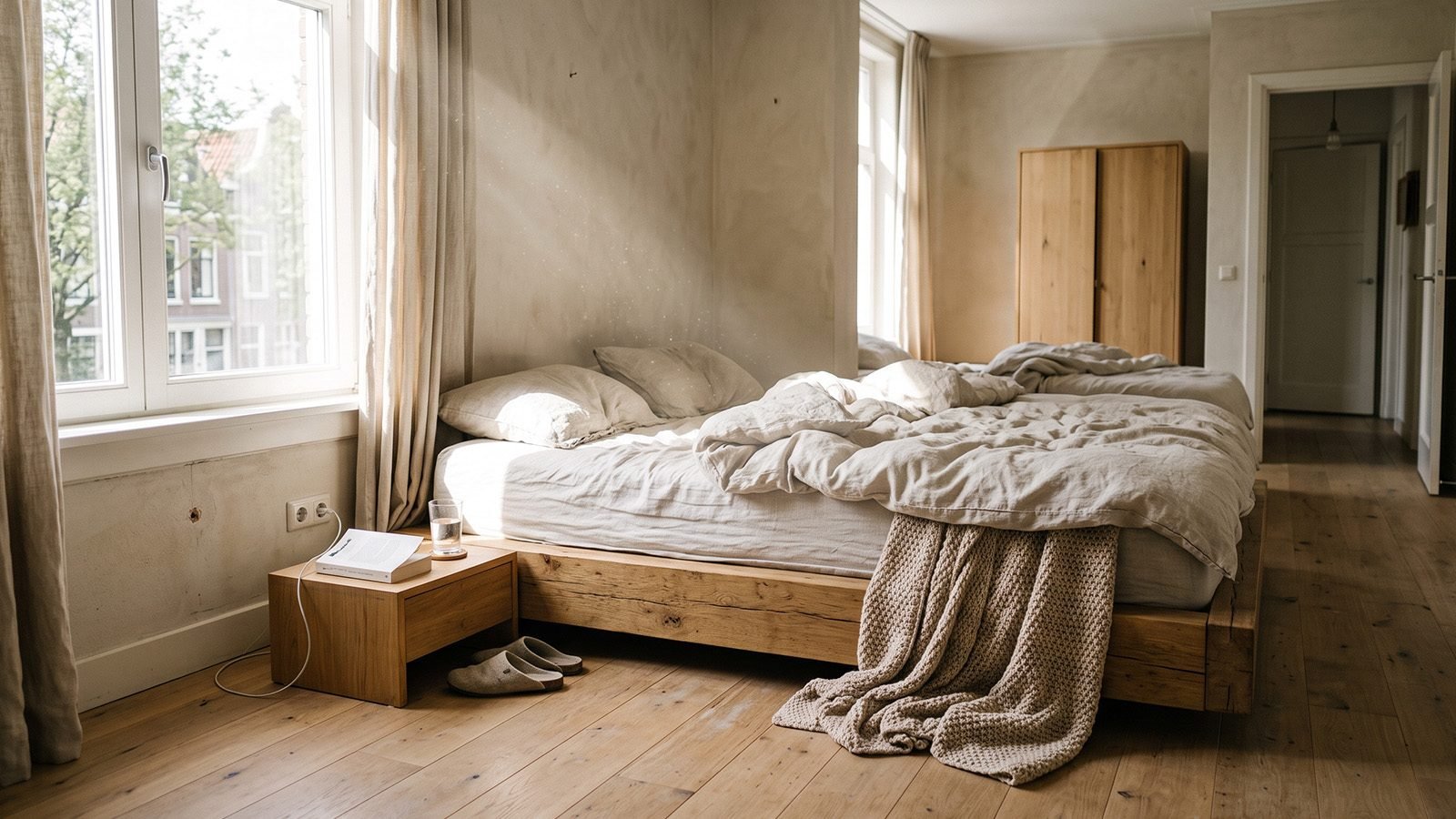
Most lighting advice for warm minimal interiors tells you to put 2700K bulbs everywhere and stop thinking about it. That advice is half right, and the half that is wrong is doing real damage to how you sleep.
Warm light is correct in the evening. It is a poor choice as your only daytime light source, because the same quality that makes it feel calm at night is what makes it biologically inert at ten in the morning.
Why colour temperature is not the whole story
Your eyes contain receptors that have nothing to do with vision. They do not help you see. They report to the part of the brain that sets your body clock, and they respond most strongly to the blue-heavy wavelengths present in daylight.
The metric lighting professionals use for this is melanopic EDI, which measures how much circadian stimulus a light source actually delivers rather than how bright it looks. Current guidance from CIE Technical Note 015:2023 puts daytime above 250 lux melanopic EDI, evening below 10, and night below 1.
The number that matters for anyone decorating with warm bulbs: 2700K LEDs have a melanopic ratio of roughly 0.40, against 1.0 for 6500K daylight. In plain terms, a warm bulb delivers well under half the circadian signal of daylight at the same apparent brightness.
That is exactly what you want after sunset. It is close to useless at breakfast.
The two shift approach
Stop assigning colour temperature by room and start assigning it by time.
Daytime, roughly 7am to 4pm. You need genuine circadian stimulus, and the cheapest source by an enormous margin is the window. A typical 3500K ceiling light tops out around 80 melanopic EDI, far below the 250 daytime figure, which tells you how badly indoor electric light performs against the outdoors even before you warm it down.
So: open the curtains fully, and take breakfast or coffee within sight of the largest window in the house. Sheer unbleached linen is the right window treatment here precisely because it diffuses without blocking.
Evening, sunset onward. Now warm and dim is the correct answer. 2700K or lower, on dimmers, at low levels, positioned low in the room. This is where every piece of Japandi lighting advice you have read applies fully.
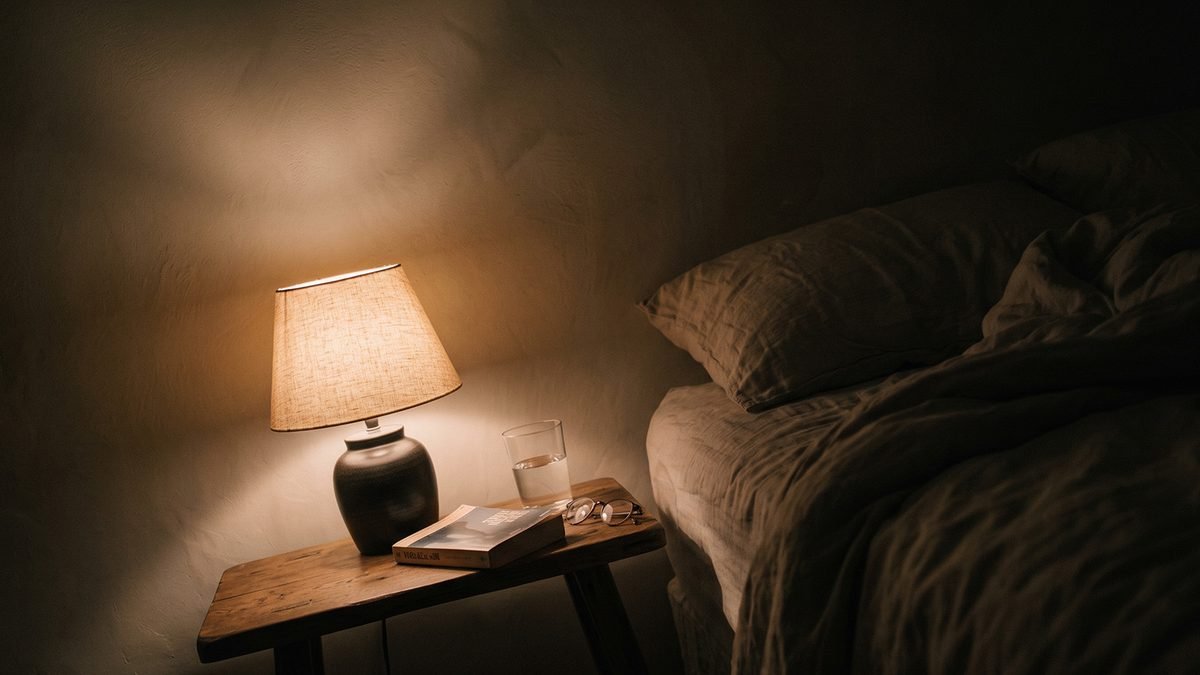
What this means for the bedroom specifically
The bedroom is where getting this wrong costs the most, and it is usually the room people optimise last.
No overhead light after dark. A ceiling fixture puts light directly into your upper visual field, which is where those receptors are most sensitive. A paper lantern floor lamp or a low table lamp with a linen shade puts light below eye level, where it reads as fire rather than sky.
Get the light source low. Japandi already wants low furniture. A lamp on a low bedside table at roughly mattress height is both stylistically and biologically correct, which is a rare alignment.
Layer rather than brighten. Two low sources at 15 watts each produce a calmer room than one at 40, because the eye reads pooled light as evening and flat even light as daytime.
Morning matters more than people think. A bedroom with heavy blackout curtains and no morning light exposure works against you every day. If you need blackout to sleep, open them the moment you wake rather than after coffee.
The materials part, which does more than people expect
Light in a room is not just what leaves the bulb. It is what the room does with it afterward, and Japandi materials happen to be unusually good at this.
Limewashed and clay walls scatter light unevenly, producing soft gradients rather than the flat wash you get off eggshell acrylic. Fewer harsh shadows, gentler falloff.
Matte oak absorbs and warms. Gloss finishes create specular hotspots, small bright reflections the eye reads as visual noise. Matte and hardwax oiled surfaces have none.
Linen diffuses. Heavy unbleached linen curtains turn direct sun into soft ambient light without killing it. The single most useful window treatment in the style.
Avoid mirrors opposite the bed and large glossy surfaces near light sources. Both bounce hard light back at you at exactly the moment you are trying to wind down.
The correction to the standard advice
The piece on why minimal rooms feel like hotel lobbies says replace every bulb with 2700K to 3000K. That remains right for a living room used mainly in the evening, and it fixes the sterile problem immediately.
Refining it: in a room you use through the day, particularly a home office or a kitchen where you eat breakfast, running warm bulbs as your only source is a genuine tradeoff. The honest answer is that the fix is not a cooler bulb, which would wreck the palette. The fix is daylight. Sit near the window in the morning and let the electric lighting stay warm.
If a room genuinely has no daylight access and you work in it, that is the one case where a cooler daytime source earns its place, on a separate switch, used only until mid afternoon.
A simple evening sequence
- At sunset, turn off anything overhead.
- Two low sources only. A floor lamp and a table lamp, both warm, both dimmed.
- Screens down or warmed for the last hour. Phone and laptop are bright sources held close to the face, which makes them disproportionately powerful.
- Bedroom light stays under the level you would read fine print by. If it is comfortable to read a contract, it is brighter than it needs to be.
- Curtains open first thing. Before coffee, before the phone.
None of that requires buying anything, which is the point. The lighting layer of this style is mostly a sequence, not a shopping list.
If the evening half of this is what interests you, The Dark Layer is built for exactly that room: nine assets around a single anchor colour, wall art and guides for a space that works after the lights come down, plus an audio companion meant for the hour before sleep. See The Dark Layer.