
Rooms
The Japandi Entryway: Designing the Threshold
The entryway is decorated last and seen by everyone. Five decisions that fix it, the genkan idea behind shoes-off, and the reset habit that keeps it working.
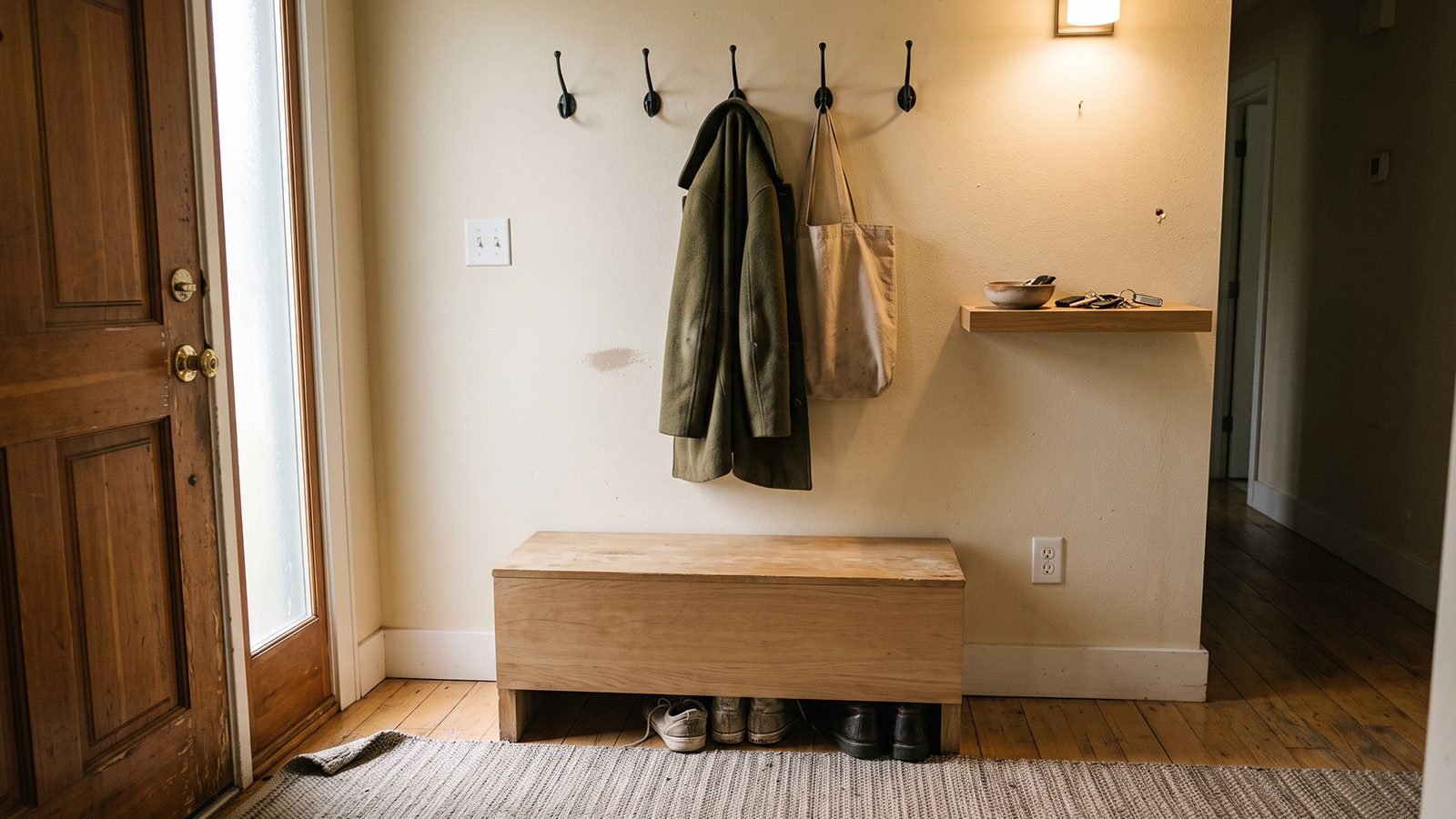
The entryway is the room people decorate last and the only one every visitor experiences. It is also the room where Japandi has an unfair advantage, because the style was partly built around the idea that arriving home is a transition worth marking.
In a traditional Japanese house the genkan is a recessed area where shoes come off before you step up into the living space. The physical step is the point: the house is a different place from the street, and you cross a threshold to enter it. Almost no American house has this, but the thinking transfers.
The problem with most entryways
They are small, they take the most abuse of any space in the house, and they accumulate objects nobody has decided where to put. Mail, keys, packages, sunglasses, dog leads, single gloves.
The usual response is to add furniture, and in a narrow hallway that makes it worse. The correct response is to give each recurring object one assigned home, and to keep almost everything off the floor.
Five decisions that do most of the work
1. A bench, low, with closed storage underneath.
The bench is not optional. Without somewhere to sit, shoes get removed standing up, which people do badly and inconsistently, and a shoes-off house depends on the removal being easy. Low, in the region of 16 to 18 inches, in light oak, with either a hinged lid or a solid front hiding what is inside.
Open cubbies are the mistake here. Shoes displayed on shelves is visual noise in the busiest sightline in the house.
2. Hooks, not a coat rack.
A freestanding coat rack occupies floor space in a room that has none, and it always ends up overloaded and leaning. A row of wall hooks at roughly 60 inches, plus a lower row at around 42 inches if children live there, does the same job and vanishes when empty.
Blackened steel or aged brass. Four to six hooks maximum. More hooks does not solve overflow, it just relocates the overflow onto the wall.
3. One dish for keys and small metal.
A single unglazed ceramic dish on a low console or a wall shelf. This is the one place in a Japandi house where a small object is doing pure function and earning its surface.
The rule that makes it work: nothing else on that surface. The moment a second object appears, it becomes a drop zone and within a fortnight there is mail on it.
4. A rug that can take grit.
This is the one location where the standard advice about jute is worth reconsidering, though not reversing. Entry rugs face grit, water and salt, and they are consumable in a way a living room rug is not.
A flatweave wool runner still outperforms jute for cleaning, but the honest position is that whatever you put here will need replacing eventually. Buy accordingly, and put the good rug somewhere else.
5. One mirror, and only here.
Japandi generally avoids large mirrors, since reflective surfaces fight the matte material logic of the style. The entryway is the exception, for two practical reasons: people genuinely check themselves before leaving, and a narrow dark hallway benefits from bounced light more than any other space.
One mirror, simple frame in oak or blackened steel, hung lower than instinct suggests. This is still a room built around low horizontal lines.
Lighting the threshold
Most American entryways have one overhead fixture, often the harshest in the house, frequently cool white. It is the first light you meet when you come home and it is usually the least welcoming.
Swap it to 2700K immediately. Better, if there is any surface at all, add a small low lamp and use that in the evening instead of the overhead. Arriving into low warm light rather than overhead glare changes the experience of coming home more than any object in the room.
If the space genuinely has no surface for a lamp, a wall sconce at around 60 inches on a warm bulb does the same job.
The shoes-off question
If you are adopting the genkan thinking, be practical about it. Shoes off is normal in much of the world and awkward for many American guests, who will not expect it.
What makes it work without anyone feeling ambushed: a bench that is obviously for sitting, shoes visibly already off and stored by the door, and a basket of clean house slippers within reach. Nobody needs to be asked. The room communicates it, and the slippers remove the objection people actually have, which is being barefoot in someone else's house.
What does not work: a sign asking people to remove their shoes. It reads as instruction rather than hospitality, and it is the one decorative object in this entire style guide we would tell you to avoid outright.
Small entry, tight rules
If the space is genuinely tiny, a hallway rather than a room, cut to the minimum:
-
Hooks and a shelf. No bench, no console. A narrow wall shelf at around 48 inches with one ceramic dish on it, hooks below or beside.
-
Shoe storage elsewhere. A closed cabinet just inside the adjacent room rather than a rack in the hall.
-
Nothing on the floor. In a narrow space, floor objects read as obstruction rather than furnishing. Everything wall mounted.
-
One texture moment. A single linen curtain, a small wall hanging, or a wool runner. Small spaces still need soft material, they just need less of it.
The reset habit
Entryways fail through accumulation rather than through bad design. The design holds for about three weeks and then the drop zone reasserts itself.
The habit that keeps it: everything that arrives in the entryway leaves it the same day. Mail gets opened and binned or filed, packages get unpacked, bags go to their room. The entry is a transition space and nothing lives there permanently except the dish, the hooks and the bench.
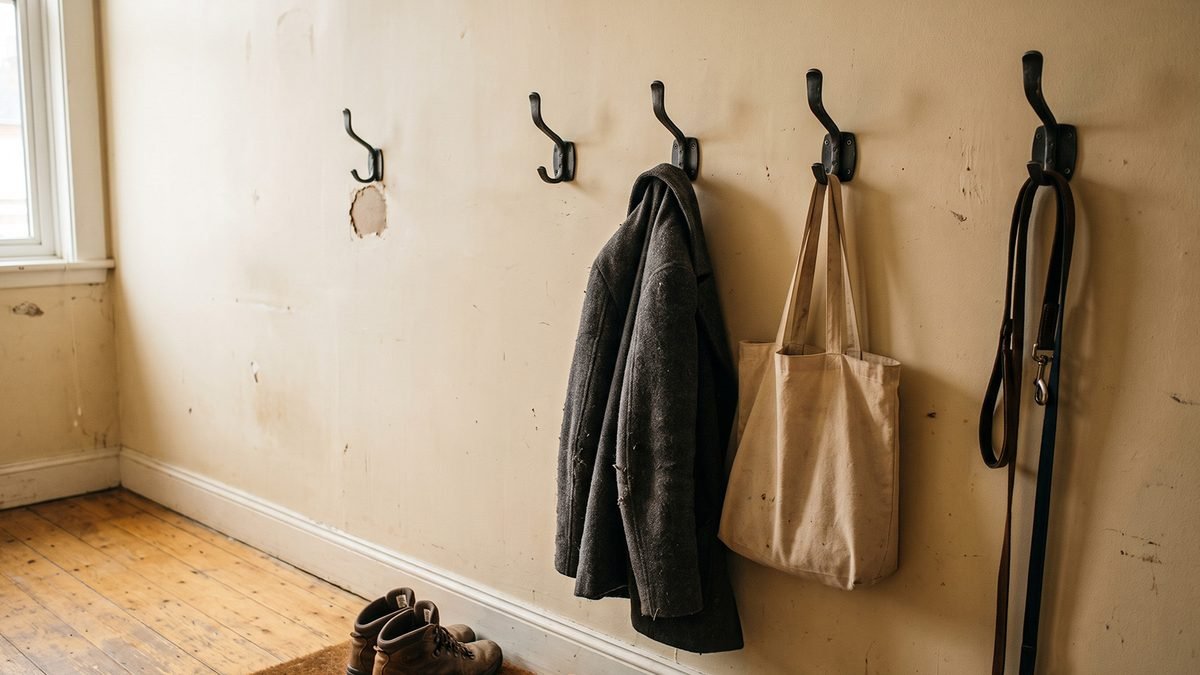
That takes about ninety seconds a day, and it is the difference between an entryway that looks like this in a photograph and one that looks like this in March.
The entryway is the smallest wall in the house and the one every visitor sees, which makes it the easiest place to get a single piece exactly right. The Sanctuary bundle includes wall art built around ma and wabi-sabi, sized for exactly this kind of narrow considered space. See The Sanctuary.