
Principles
Danshari: Why Buying Storage Is Not Decluttering
Buying storage containers is not decluttering. Danshari explained: refuse, dispose, detach, in that order, and why decluttering must come before you decorate.
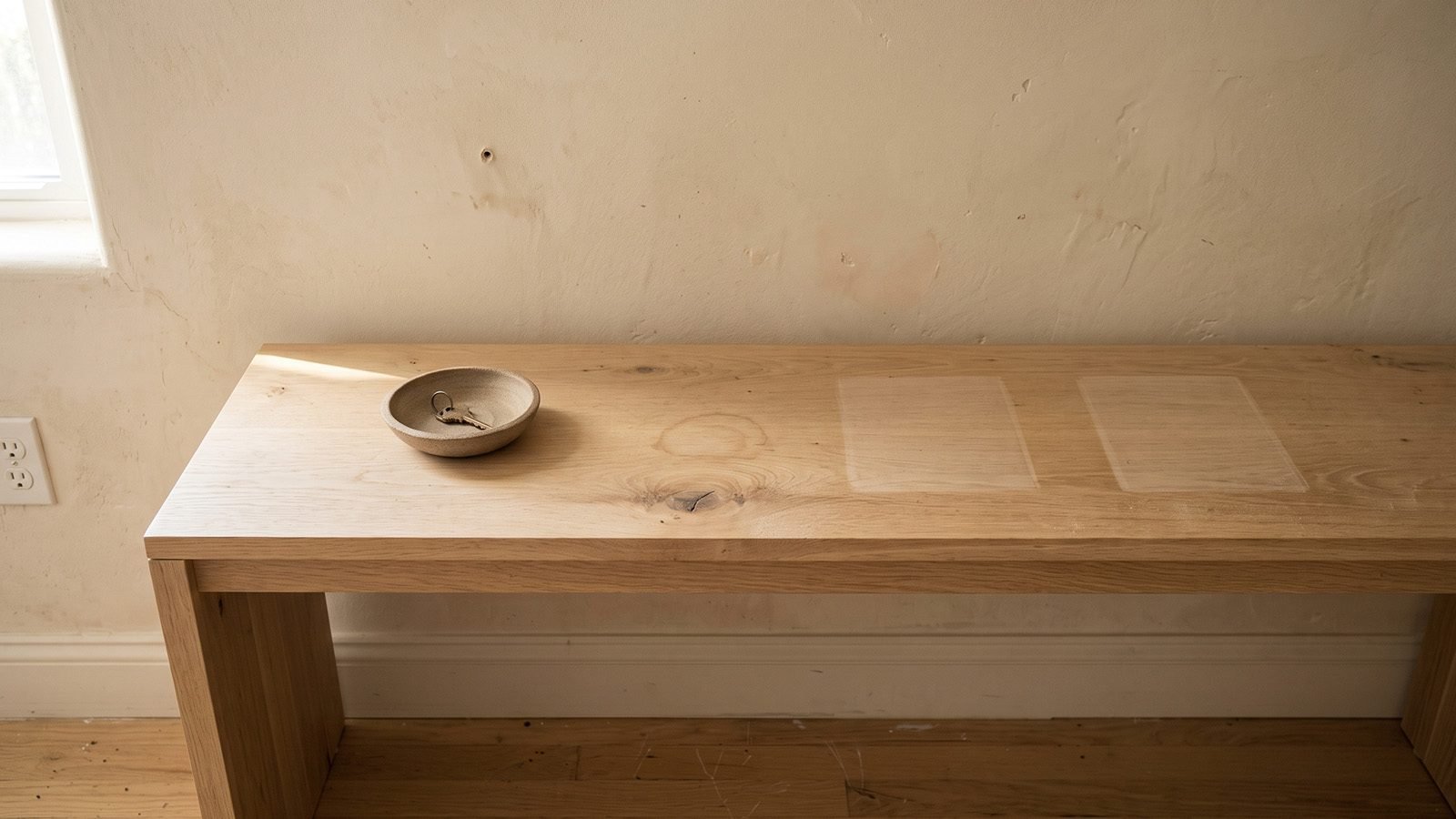
Buying storage containers is not decluttering. It is paying money to keep things you have already decided you do not need, and it is the single most common way a Japandi project stalls before it starts.
Danshari is the Japanese approach to this, and it is structured around three ideas that happen in a specific order. Dan, refusing what would come in. Sha, disposing of what is already here. Ri, detaching from the urge to possess in the first place.
The order matters. Most Western decluttering skips straight to the middle step, which is why people declutter the same drawer four times a year.
Why this comes before decorating
You cannot execute a style built on negative space in a house that is full. Every design decision downstream depends on this one, and no purchase compensates for skipping it.
The practical proof: most people who buy Japandi furniture into a full house end up with the same amount of stuff arranged around nicer objects. The room reads as busy, they conclude the style does not suit them, and the furniture gets blamed for a problem it was never able to solve.
Do this first. It costs nothing, it takes a weekend, and it will change what you buy afterward, usually by reducing it.
Dan: stopping the inflow
This is the step that makes the other two permanent, and almost nobody does it first.
If your house takes in more than it releases, no amount of clearing will hold. You will simply repeat the exercise. Before removing anything, close the taps.
Unsubscribe from retail email. Every one of them. This is twenty minutes of work and it removes most impulse purchasing at the source, because the majority of unplanned buying starts with being told about a sale you were not looking for.
Institute a waiting period. Anything non essential goes on a list and waits a week. A significant proportion of wants evaporate in that week, and the ones that survive are usually worth having.
Refuse free things. Conference bags, hotel toiletries, promotional items, hand me downs offered out of kindness. Free objects still cost you space, attention and the eventual effort of disposal.
One in, one out, enforced. New mug in, old mug out, same day. This is the mechanism that holds a decluttered house stable for years.
Sha: releasing what is here
Only now does the clearing start, and the framing matters more than the method.
The conventional question is: do I need this? That question is almost useless, because you can construct a scenario in which you need nearly anything.
Better question: would I buy this again today, at full price, knowing what I know? This reframes the decision away from loss and toward choice. Most people find that between half and three quarters of what they own fails it.
A second question for anything sentimental: is this object carrying the memory, or am I? Photograph it if it helps. The memory is not stored in the object, and keeping thirty boxes of things you never open is not the same as honouring a person.
Work by category, not by room. All the mugs at once, all the towels at once, all the cables at once. Doing it by room hides duplication, because you never see that you own eleven mugs when they live in four different cupboards.
Ri: the part people skip
The third step is not an action, it is what the first two are for. Detachment means the pull to acquire loosens, and you stop needing the discipline because the desire itself has quietened.
This sounds abstract and it produces a very concrete result: you walk through a store and feel nothing. Not restraint, which is effortful and temporary. Just an absence of pull.
Most people report this arriving somewhere between three and six months after they seriously stop bringing things in. It is the difference between a decluttered house and a person who no longer accumulates, and it is the only version that lasts.
Where danshari and KonMari part ways
Worth distinguishing, because they get conflated constantly in American coverage.
The spark joy method asks what to keep, and it is fundamentally about curating a collection of things you love. It is warm, it is emotionally intelligent, and it is still a framework centred on your relationship with objects.
Danshari asks what to refuse, and its endpoint is a reduced relationship with objects altogether. Less a curation exercise, more a stepping back.
Both work. If you have tried the joy question and found yourself keeping most things because most things spark a little joy, the refusal framing may suit you better.
The traps
Buying organisers. Baskets, drawer dividers, labelled bins. These convert visible clutter into hidden clutter and give you the satisfaction of having solved something. Buy storage only after the reduction, only for what remains, and only when you know the dimensions.
The maybe box. A box of undecided items stored for six months. This is deferral dressed as a decision. If you must use one, tape it shut, write the date on it, and if it is unopened at six months, it goes unopened.
Decluttering as a project instead of a practice. A weekend blitz followed by a year of accumulation nets to zero. The one in one out rule is worth more than any single heroic weekend.
Sunk cost. Keeping an expensive mistake because it was expensive. The money is gone either way. The only live question is whether the object earns its space now.
Start here, this weekend
- Unsubscribe from every retail email. Twenty minutes.
- One category, fully. Mugs, or t-shirts, or cables. Every one in the house, on one surface, at the same time.
- Apply the buy again question to each item, quickly. Slow deliberation produces worse results than instinct here.
- Get the leaving items out of the house within 48 hours. Bags sitting in the hall get unpacked. Book the collection before you start sorting.
- One in one out, from today. No exceptions for a month.
Do not decorate yet. Live in the reduced version for two weeks first, and then look at the room again. The list of things it still needs will be considerably shorter than the one you would have written before, and that is the entire financial argument for doing this first.
Once the house is lighter, the question becomes what the room actually still needs, and the answer is usually less than you would have guessed a month earlier. The free Japandi Starter Guide covers what to add back first and in what order. Get the Japandi Starter Guide.