
Dark Japandi
Going Dark Without Starting Over: Converting a Light Japandi Room
You do not need to start over. Most of a light Japandi room converts untouched. What stays, what has to change, the order to do it in, and the half-way trap.
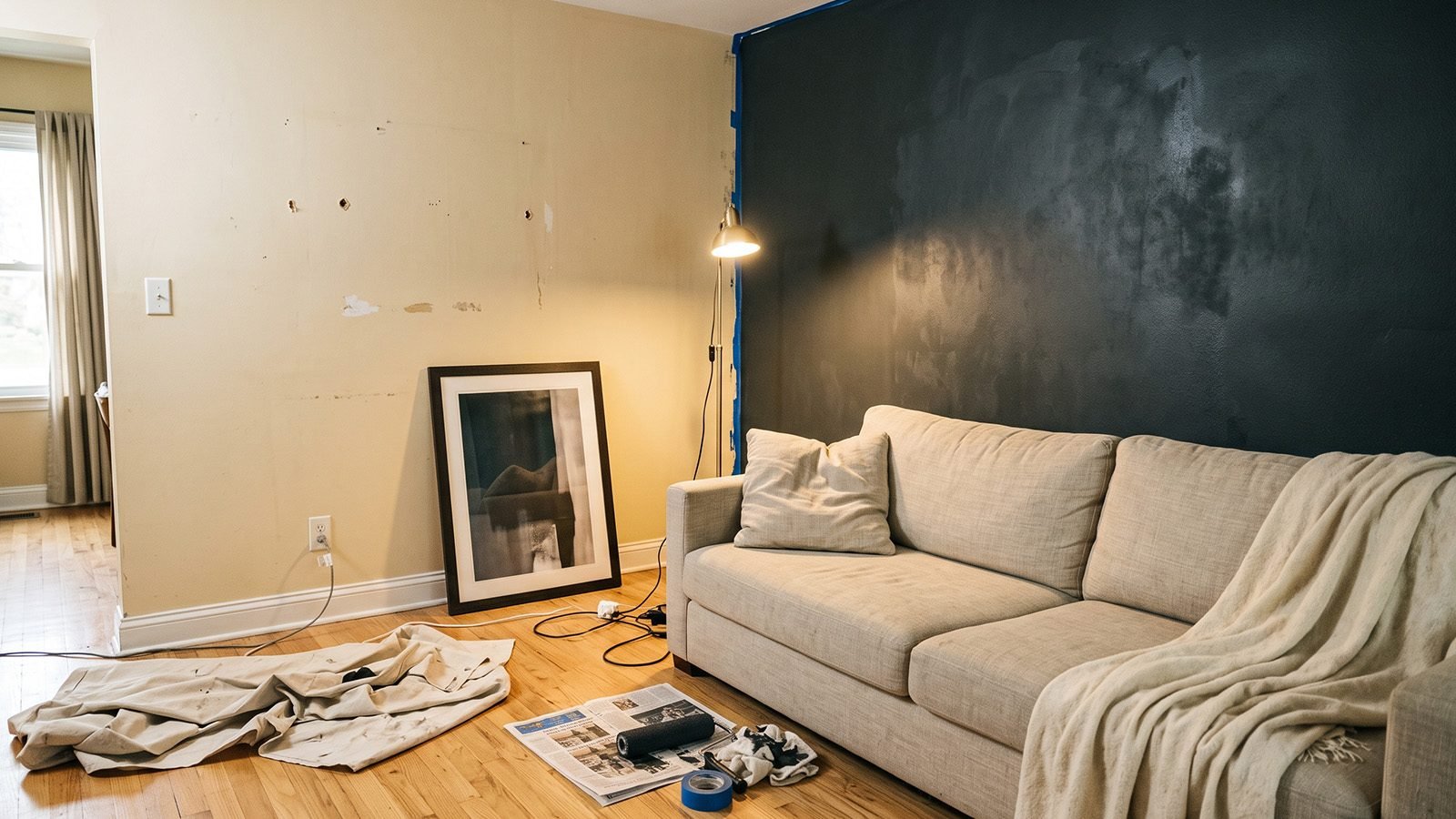
You do not need to start over. Most of a well-executed light Japandi room converts to the dark version untouched, and the pieces that do not are identifiable before you spend anything.
The reason this feels like a rebuild is that the reference images look like completely different rooms. They are not. They are largely the same furniture against a different wall, lit differently.
Why this is happening to a lot of people at once
If you executed this style between roughly 2020 and 2022, you built a room in the palette of that moment: cool-leaning neutrals, pale everything, high brightness.
Two things have shifted since. The palette warmed, moving toward clay, terracotta and honey-toned wood. And the style developed a darker branch that is now the dominant direction in current coverage.
So a room that was correct three years ago now reads as slightly dated in a way that is hard to name from inside it. That is not a failure of your taste. It is a style maturing, which is what established styles do.
What converts untouched
This is the part nobody tells you, and it is most of your room.
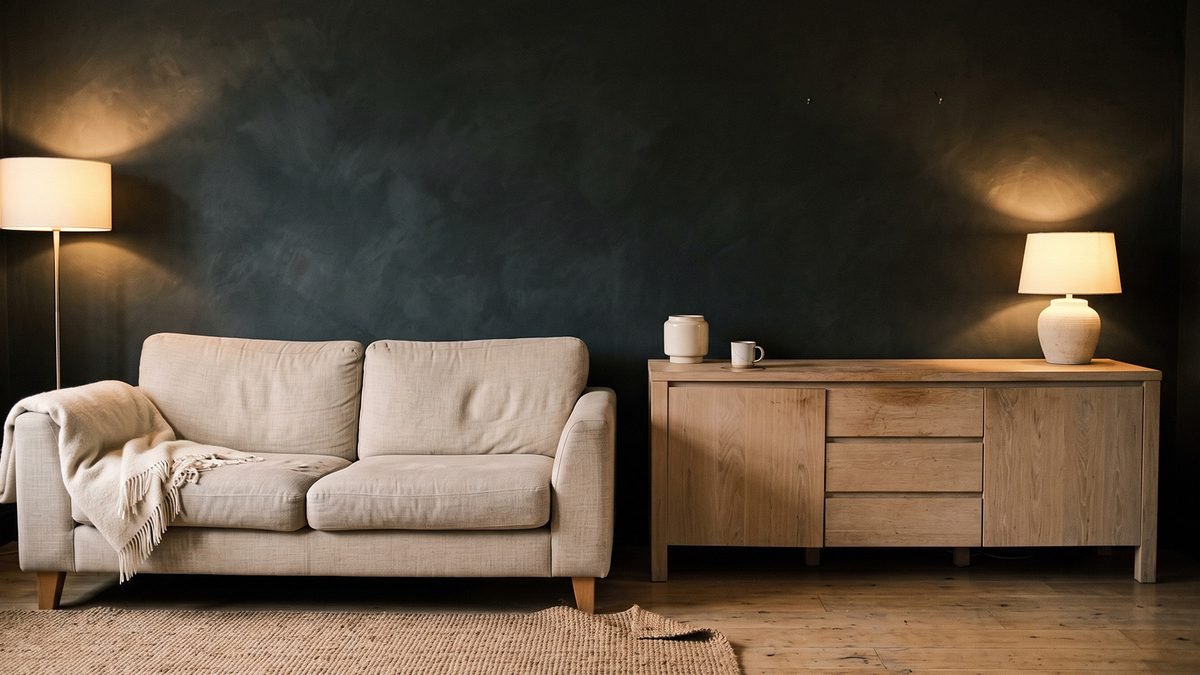
All the wood. Light oak, ash and walnut work in both directions. A dark palette does not require dark furniture, and in fact pale oak against charcoal is the single strongest combination the dark version has.
All the linen and wool. Oatmeal, cream and undyed textiles become more valuable in a dark room, not less, because they are the pale anchors the contrast depends on.
All the ceramic. Unglazed and matte stoneware performs identically against either background.
All the jute and natural fibre. Unchanged.
Every piece of low furniture. Proportion rules do not shift with palette. If your seat heights and back heights are right, they stay right.
Your lighting fixtures. Warm and low is warm and low.
Run through your room with that list. In most cases eighty percent of what you own is already correct, which changes the budget conversation entirely.
What actually has to change
Three things, in order of impact.
1. One wall finish. This is the conversion. A single dark matte plane, ideally limewash or clay rather than paint, behind the main seating or the bed.
2. One large soft surface. A charcoal rug, dark curtains, or a dark throw at genuine scale. Textiles carry a palette shift faster and cheaper than anything else, and they are removable if you change your mind.
3. The wall art. This is the one people skip and it is the reason half-converted rooms look wrong. Art chosen for a pale wall usually fails against a dark one, because contrast inverts and the framing logic changes. Pale art on charcoal reads as a bright rectangle punched into the wall, which can be exactly right or completely wrong depending on scale and mount.
Everything else is optional.
The order to do it in
Cheapest and most reversible first. This is not caution for its own sake, it is because you genuinely do not know whether you want this until you have lived with some of it.
Step one, textiles. One dark throw and one dark cushion. Twenty minutes, minimal cost, fully reversible. Live with it a week.
Step two, the rug or the curtains. Larger commitment, still removable. Another week.
Step three, sample the wall. A full square yard of the actual finish, in the actual room, checked in morning light, midday and at night under your lamps. Charcoal shifts enormously between those three.
Step four, paint the wall.
Step five, replace the art. Last, deliberately, once the wall exists and you can judge against it rather than imagining.
Most conversion regret comes from doing step four first.
The half-way trap
This is the failure mode specific to conversions and it catches almost everyone.
A room caught between two palettes does not read as transitional. It reads as unfinished. Half the walls dark and half the art still chosen for the light version produces a space that feels like a job someone abandoned, and people conclude the dark direction was a mistake when the actual problem is that they stopped at sixty percent.
Two rules that avoid it:
Finish one room completely before starting another. A fully converted bedroom and an untouched living room is fine. Two half-converted rooms is not.
Within a room, if you commit to the wall, commit to the art in the same month. The gap between those two steps is where the unfinished feeling lives.
Room by room, not house wide
Do not convert an entire home. Very few houses want to be dark throughout, and the ones that pull it off have architecture and daylight most do not.
The rooms that take it best are the ones used mainly after dark: bedroom, snug, dining room, a media room. The rooms that resist it are kitchens, home offices, bathrooms and entryways, all of which are daytime rooms or small ones.
A house with two dark rooms and four light ones is not inconsistent. It is a house where each room was resolved for how it is used, which is a more sophisticated result than uniformity.
Decide the palette before you buy the art
The practical trap in all of this: people buy wall art for the room they have, then change the room, then discover the art no longer works and buy again.
The art is the element most sensitive to the background it hangs on and the one people replace last. If you are anywhere in this conversion, or even considering it, settle the palette question before you commit to what goes on the wall rather than after.
That is the whole argument. Everything else in the room is palette-agnostic. The art is not.
You are standing in a room built for one palette and planning a room built for the other. That is the exact situation the Complete Collection exists for: all 17 assets across both the light and the dark, so the conversion does not cost you a second purchase halfway through. See the Complete Collection.