
Materials
Aged Brass or Blackened Steel: Choosing Your One Metal
Metal is the fourth material in a Japandi room and the one people choose by accident. Aged brass or blackened steel, why chrome fails, and how to fix a mixed room cheaply.
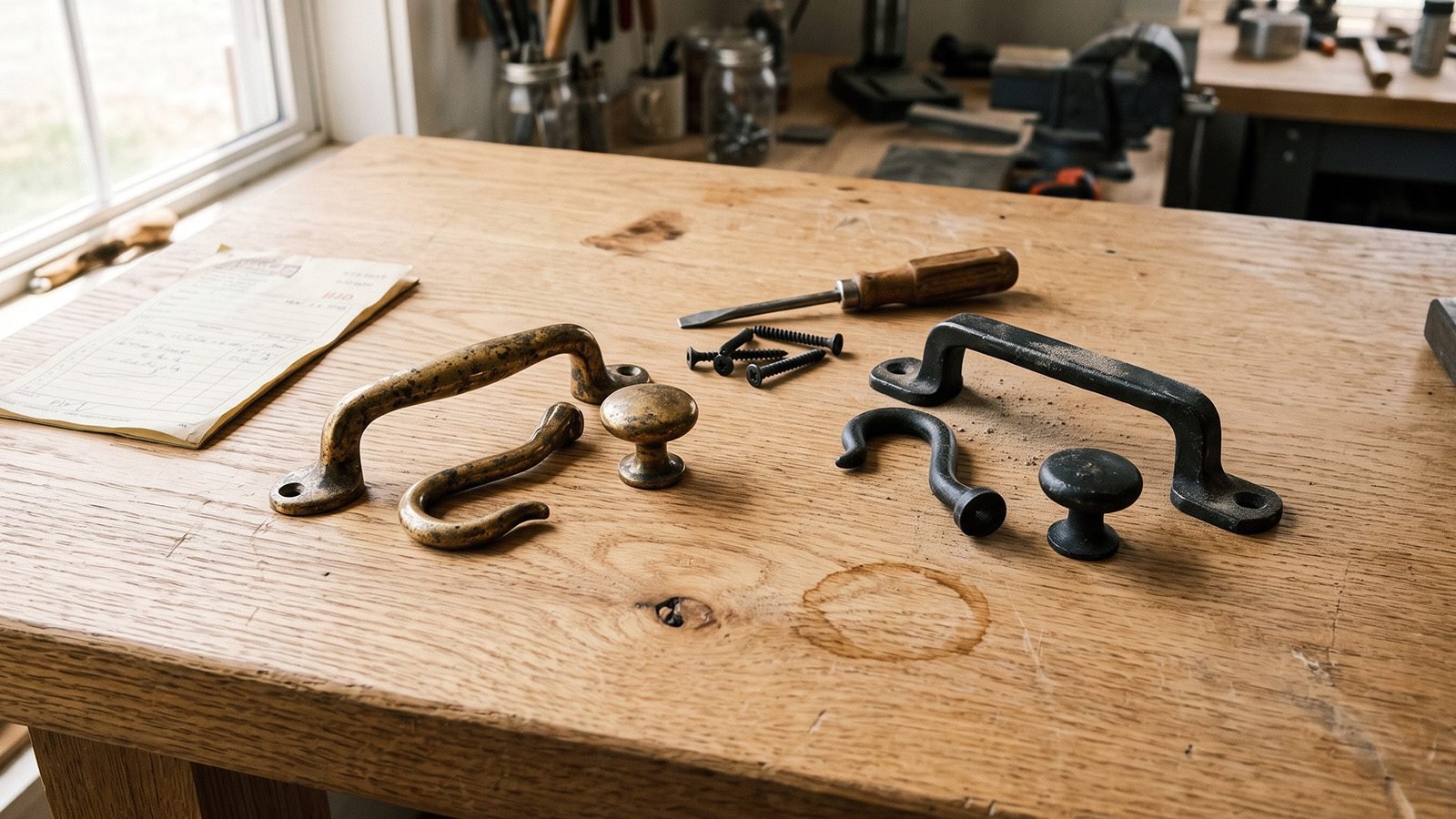
Metal is the fourth material in a Japandi room, after wood, textile and ceramic, and it is the only one most people choose by accident. Taps came with the house, hinges came with the cabinets, the lamp came from somewhere else, and the frames were whatever was on sale.
Count the metal finishes in your main room right now. If the answer is more than two, that is a problem you can see even if you have never named it.
Why metal counts as a full material here
In a room with pattern, colour and ornament, hardware is a detail. In a room with three colours and six objects, every metal surface is a significant visual event.
Metal is also the only material in the palette that reflects. Wood, linen, clay and lime all absorb or scatter light. A metal fitting returns it, which means it draws the eye disproportionately to its size. A row of six cabinet pulls is a row of six bright points at eye level.
That is why the rule here is stricter than in most styles: two metals maximum, and one is better.
Aged brass
What it is: unlacquered or lightly lacquered brass, warm and yellow, which darkens and mottles with handling and time.
What it suits: the warmer direction the palette has taken. Clay walls, honey oak, terracotta accents, undyed linen. Against those, brass reads as belonging.
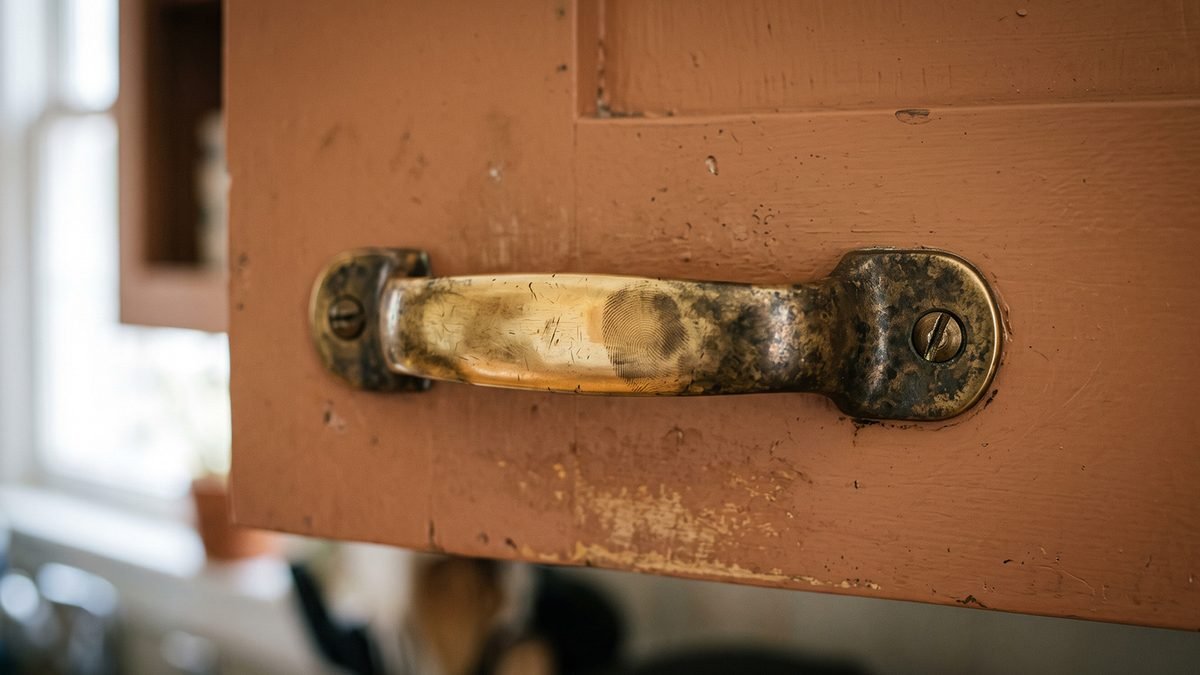
What it does over time: unlacquered brass patinas genuinely and unevenly. It goes darker where hands touch it and keeps its colour where they do not, which produces exactly the kind of use-record this style values. A brass handle after two years tells you where people grip it.
Where it goes wrong: in a cool-toned room. Brass against grey-blue walls looks like a fitting from a different house. It also fights a hard black anchor, since you then have two strong metals competing.
The lacquer question, which nobody explains: lacquered brass stays the colour it arrived. Unlacquered patinas. Both are sold as brass and they behave completely differently. If you want the ageing, you must buy unlacquered, and you cannot reverse it later without stripping.
Blackened steel
What it is: steel with a dark chemical or powder finish. Matte, neutral, and effectively colourless.
What it suits: everything. This is its actual advantage. Blackened steel does not commit the room to a temperature, which means it works in the cool early version of this style and the warmer current one equally.
What it does for the palette: it doubles as your grounding dark. If a room needs a dark anchor and you do not want a charcoal wall or a walnut console, distributed black hardware supplies the tonal separation at very small scale. In a small room this is the whole strategy.
Where it goes wrong: a room where black hardware is the only dark element and there is a lot of it can start to read as industrial rather than Japandi. The fix is fewer, larger touches rather than black on every possible item.
Maintenance: matte black shows dust and fingerprints, particularly on taps. Less than polished chrome shows water spots, but it is not maintenance free.
Why chrome and polished nickel fail
Worth being specific rather than just saying avoid them.
They are cool-toned. Polished chrome carries a blue cast that fights every warm neutral in the room. It is the same problem as a cool grey wall, at smaller scale but at eye level.
They are highly reflective. In a style built on matte surfaces, a mirror-finish fitting is the one object in the room bouncing hard light, which is why it draws the eye first.
They do not age. Chrome either looks new or looks damaged. There is no middle state, which means it never develops the record of use that everything else in the room is doing.
If your kitchen or bathroom came with chrome and replacing it is not realistic, the answer is not to add brass alongside it. Live with the chrome and keep everything else consistent.
The two-metal maximum, and how to mix if you must
One metal is cleanest. Two works if the division is logical rather than random.
Divide by function, not by room. All hardware in one metal, all lighting in the other. Or all fixed fittings in one, all freestanding objects in the other. The eye accepts a system it can detect and rejects a scatter.
Keep them tonally distant. Brass and blackened steel work together because they are obviously different. Brass and bronze, or black and dark grey, read as a mistake rather than a decision.
Weight one of them. Eighty percent one metal, twenty percent the other. An even split reads as indecision.
Consistency across a room
This is where most homes fail, and it is entirely fixable.
Walk one room and list every metal item: door handle, hinges, light switch plate, curtain rail and rings, picture hooks, lamp base, cabinet pulls, radiator fittings, the frame on the mirror.
Most rooms turn up three or four finishes. Nobody notices individually and everybody feels the result.
Fix it cheaply, in this order: cabinet pulls and curtain rails first, since they are large, visible and cheap. Then picture hooks and frames. Door hardware last, since it is the most expensive and the least noticed.
You do not need to do it in one purchase. Replace as things wear, buying only the chosen finish, and a room converges within a couple of years.
Choosing yours, in one question
Is your room warm or is it neutral?
If your walls are clay, sand or warm white, your wood is honey oak, and your textiles are undyed and warm, choose aged brass, unlacquered. It will belong immediately and improve with handling.
If your room carries a grounding dark, or you are in a small space where a large dark element would shrink the room, or you simply want the decision to stop mattering, choose blackened steel. It never fights anything.
If you cannot decide, choose blackened steel. It is the lower-risk answer, and the one you can add brass to later as the second metal without repainting anything.
Once the metal is settled, the frames on the wall are part of the same decision, and a frame in the wrong finish undoes a room faster than a wrong colour. The free Japandi Starter Guide covers the order to resolve these details in. Get the Japandi Starter Guide.