
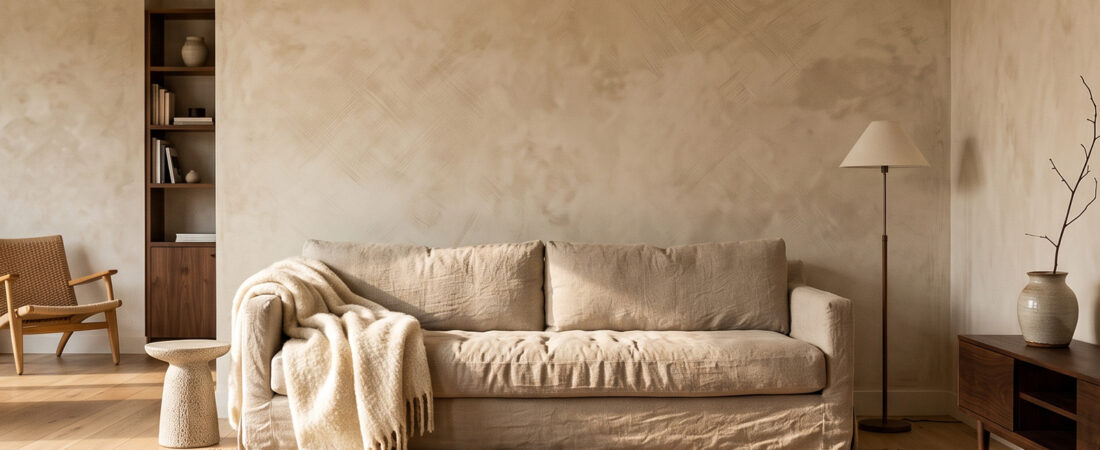
Your room is not too minimal. It is under-warmed, and those are completely different problems with completely different fixes.
The hotel lobby feeling shows up when someone executes the Japanese half of Japandi and skips the Scandinavian half. You get restraint, clean lines, neutral colors, low clutter, and none of the human warmth that makes the style livable. The result is technically correct and emotionally dead. Below are the six things that cause it, in the order they usually do the most damage.

1. Your paint has cool undertones
This is the most common cause and the hardest to see. Most popular greys and greiges sold in American paint stores carry a blue or violet undertone. Under warm afternoon light that reads as sophisticated. Under overcast light or LED bulbs it reads as institutional.
Japandi needs the opposite direction: warm off-whites with yellow, red or earth undertones. Underbaked clay, warm linen, ecru, muted sage, warm taupe. If your wall color is sitting next to raw oak and the oak suddenly looks orange, your wall is too cool. That orange cast is not the wood’s fault.
The test: hold a sheet of standard white printer paper flat against your wall in daylight. Printer paper is aggressively neutral. If your wall looks blue, grey or purple against it, you have your answer. If it looks slightly yellow, pink or brown, you are in the right family.
The fix: repaint, but consider changing the finish while you are at it. Flat and eggshell acrylics reflect light uniformly across the whole wall, which is exactly what makes a minimal room feel like a waiting area. Limewash and clay finishes absorb light unevenly and shift throughout the day, so the wall reads as a surface with depth rather than a flat plane. In a room with only a dozen objects in it, the walls have to do more work than usual.
2. Everything in the room is flawless
Pure minimalism rewards perfection. Every edge crisp, every object symmetrical, every finish uniform. Japandi punishes it. The Japanese side of this style is rooted in wabi-sabi, which honors what is worn, uneven and visibly made by hand.
When every object in a room came off a production line, the eye reads factory. Nothing in the space carries evidence of a person. That is precisely the quality that separates a home from a lobby, and it costs surprisingly little to introduce.
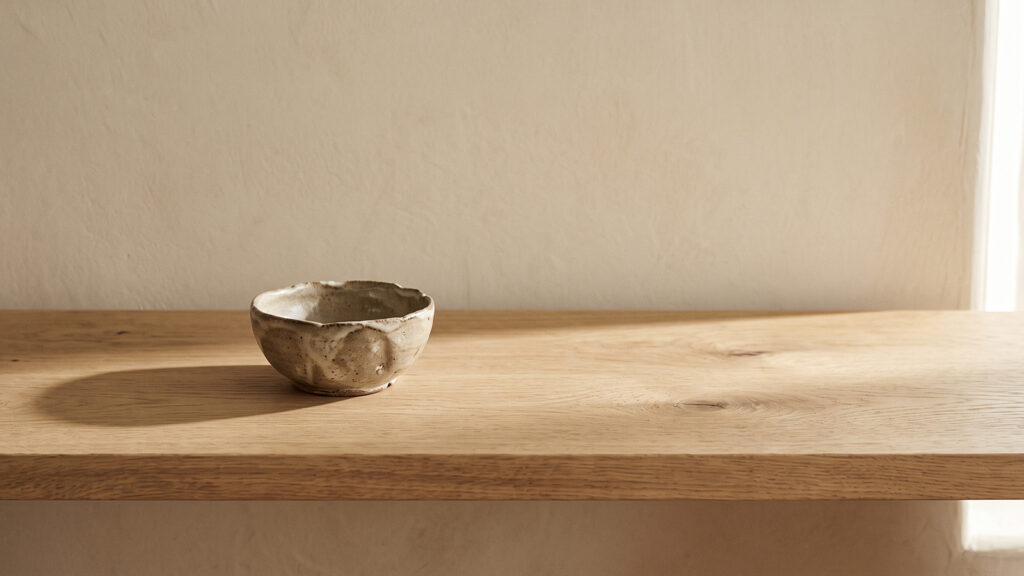
The fix: find the three most perfect objects in the room and replace one of them. A machine-pressed vase becomes a hand-thrown one with a slightly uneven rim. A glass side table becomes a solid wood stool with a visible knot. A framed print becomes a piece of unglazed ceramic. You are not aiming for shabby, you are aiming for evidence of a maker. One or two genuinely handmade pieces will carry an entire room, and buying one good thing slowly beats filling the space quickly.
One warning. Factory-distressed furniture sold as artisanal is the opposite of this. Chemically aged, machine-scuffed pieces from big box retailers read as costume, not patina. Real wear comes from use, or from a hand that made the piece unevenly on purpose. Buyers can tell the difference even when they cannot articulate why.
3. You have no texture stack
Japandi restricts color hard. Warm neutrals, one grounding dark, nothing loud. That restriction means texture has to carry all the visual interest that color usually provides, and most failed Japandi rooms have three textures where they need six.
Count yours right now. Painted drywall, upholstery, and wood is three, and three is not enough to hold a room together.
The fix: aim for at least five distinct tactile surfaces in any main room:
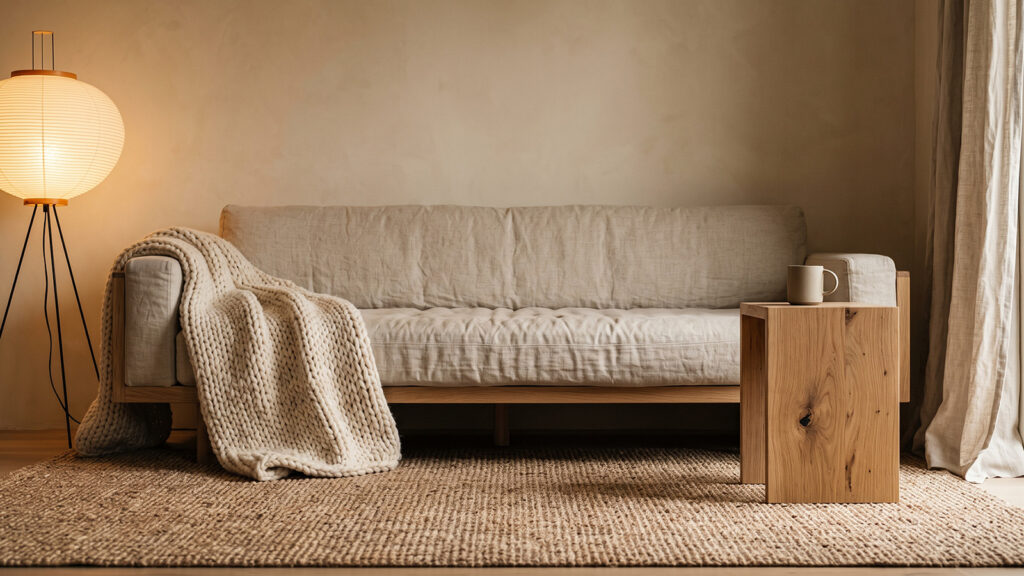
- Rough natural fiber underfoot. Jute, sisal or a flatweave wool rug with a visible weave. This one matters most because it covers the largest area.
- Wrinkled linen. Curtains, cushion covers, or bedding. Un-ironed is correct here, not lazy. The wrinkle is the texture.
- Chunky wool. A heavy knit throw, draped rather than folded. Folded throws read as staged.
- Raw or matte wood. Not high gloss polyurethane. A hardwax oil finish leaves the grain open and touchable, which is the whole point.
- Ceramic or stone. Unglazed or matte glazed. Something cool and hard against all that soft.
Stack those and a room in three colors will feel richer than a room in ten. If you are short on the soft layers, textiles are usually the cheapest single upgrade with the biggest visible return.
4. Your bulbs are 4000K
Walk into any American home improvement store and the default bulb on the shelf is cool white. It is efficient, it is bright, and it will destroy a Japandi room faster than any furniture mistake on this list.
Cool white light at 4000K and above renders warm wood tones as grey and makes off-white walls look clinical. It is the exact color temperature used in offices, retail stores and hospitals, which is why a room lit with it feels like all three.
The fix: replace every ambient bulb in the room with 2700K to 3000K warm white. This is a thirty dollar change that does more than a thousand dollar sofa.
Then fix the layers. A single overhead fixture flattens everything beneath it and casts hard downward shadows. You want three sources at different heights: an ambient source on a dimmer, a task light at seated eye level such as a paper lantern floor lamp, and a low accent light such as a small ceramic table lamp with a linen shade. Three warm pools of light at three heights reads as evening calm. One bright ceiling fixture reads as a conference room.
5. Your furniture is built to American proportions
Standard American upholstery is tall, deep and heavily stuffed. Rolled arms, thick cushions, high backs, chunky legs. Drop one of those sofas into a Japandi room and the spatial harmony collapses regardless of what color it is.
Japandi furniture sits low. Seat heights under roughly 16 inches, platform beds without towering headboards, console tables and side tables that stay well below eyeline. This is not an arbitrary style rule. Lowering the horizontal line of the furniture drops the visual weight of the room toward the floor, opens up the upper half of the wall, and makes a standard eight foot ceiling feel noticeably taller.
The fix: if replacing the sofa is not realistic right now, work around it. Swap the coffee table for something lower. Remove any tall floor lamps and replace them with low ones. Hang art lower than feels natural, closer to seated eye level than standing. You are trying to pull the entire visual center of gravity downward, and a rearrangement gets you most of the way there for free.
When you do buy, look for clean rectangular geometry and slim legs in light oak or walnut. Avoid rolled arms, deep tufting and anything described as overstuffed.
6. Every surface is styled
This one is counterintuitive because it looks like effort. If every shelf holds a carefully arranged trio of objects and every surface has something on it, the room stops reading as a home and starts reading as merchandising.
Empty space in Japandi is not an absence. It functions as a material in its own right, the thing that gives the few present objects room to register. Fill every plane and nothing stands out, including the pieces you spent the most on.
The fix: the Rule of One. Pick your longest console or widest shelf and put exactly one object on it, positioned off center. Leave the rest bare. It will feel wrong for about two days and then it will feel like the best decision in the room.
While you are there, remove word signs, generic catalog art, and anything bought purely to fill a gap. Every object in a Japandi room should either do a job or be genuinely beautiful to look at. Most decorative filler does neither.
The 10 minute audit
Run this tonight, in the room that is bothering you:
- Hold printer paper against the wall. Blue or grey means the palette is the problem.
- Count distinct textures. Under five means texture is the problem.
- Check a bulb. 4000K or higher means lighting is the problem.
- Count objects that were made by a person rather than a machine. Zero means warmth is the problem.
- Sit down and look at the room from seated height. If everything towers over you, scale is the problem.
- Find one surface with three or more objects on it. Clear it to one.
Most rooms fail three or four of these at once, which is why the whole space feels off rather than one identifiable thing looking wrong.
If you ran that audit and found four problems instead of one, you do not need six separate fixes. You need an order to do them in.
Start with light
If you only do one thing, change the bulbs. It is the cheapest fix on the list, it takes ten minutes, and it changes how every other material in the room renders. Warm light makes oak look like oak again and makes an imperfect wall color considerably more forgivable.
Then add texture, then fix the palette, then deal with furniture scale when the budget allows. In that order the room improves at every step instead of sitting half finished for months.